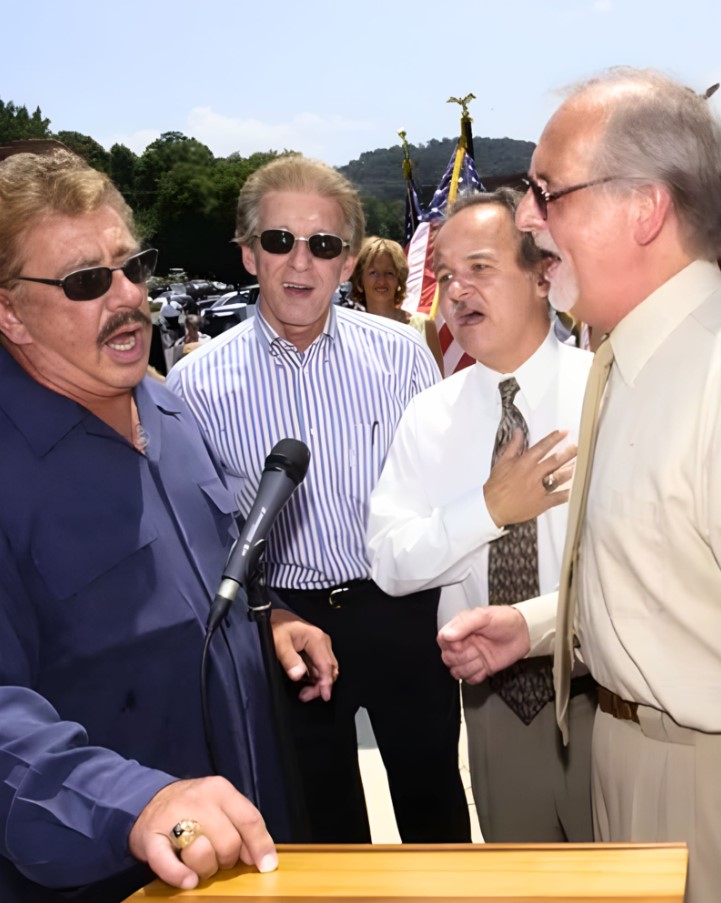
Few voices in country music history have blended as naturally and powerfully as The Statler Brothers. Their harmonies didn’t just complement each other — they completed each other. There’s something haunting about the way their voices rise and fall together, as if echoing stories from a time when music carried both comfort and consequence. In this performance, that bond takes on a deeper meaning — a tale of guilt, justice, and memory that lingers long after the last note fades.
A Performance That Stopped the Room Cold
It wasn’t meant to be a spectacle. It began quietly — four men standing under the warm glow of stage lights, guitars in hand, eyes lowered in thought. But as soon as Harold Reid’s deep bass set the tone and Don Reid’s steady lead carried the first verse, the air changed. The audience went silent. There was weight in the words, and in the pauses between them, something unspoken hung heavy — regret, perhaps, or remembrance.
Each line felt like a confession, and every harmony like a prayer for redemption. It was more than a song. It was a reckoning.
The Song That Spoke of Guilt and Grace
The Statler Brothers had always known how to balance humor and heartbreak, but this moment was different. The song — written years earlier and rarely performed live — tells the story of a man haunted by what he’s done and what he can never undo. In their hands, it became a living story. Jimmy Fortune’s soaring tenor gave voice to the man’s conscience, while Phil Balsley’s steady baritone anchored the melody like the weight of time itself.
Listeners said afterward that it felt like standing inside a memory, where melody and meaning blurred together. Each verse built toward quiet understanding — not forgiveness, but acceptance. The Statlers weren’t just performing; they were testifying.
Voices That Carry Generations of Truth
There’s a reason The Statler Brothers remain icons decades after their final bow. Their voices were instruments of truth and storytelling, capable of evoking laughter one moment and tears the next. In this performance, that gift reached its purest form. Every harmony sounded deliberate, earned.
Their music has always carried the spirit of small towns, front porches, and Sunday mornings — but here, it carried something deeper: the sound of reckoning with one’s own soul. For those who grew up with their songs, it felt like returning home to face something long buried.
A Moment Beyond Music
When the final chord rang out, there was no applause at first — only stillness. Some said it felt like time had paused, as if everyone in the room shared the same thought: that memory is both a blessing and a burden. Only after a few seconds did the crowd rise, not cheering but standing in quiet reverence.
It was one of those rare performances where music becomes memory, and memory becomes something almost sacred. The Statler Brothers didn’t need pyrotechnics or spectacle — their harmony was enough to pierce straight to the heart.
The Legacy That Refuses to Fade
Long after the lights dimmed and the echoes faded, that night stayed alive in the minds of everyone who witnessed it. It reminded us why we listen — not just for melody, but for meaning. The Statler Brothers’ haunting harmony lives on as a reminder that the past never truly leaves us; it sings through us, in whispers and in songs, as long as we remember to listen.
And perhaps that’s the truest measure of music’s power — not the applause it earns, but the silence it leaves behind.