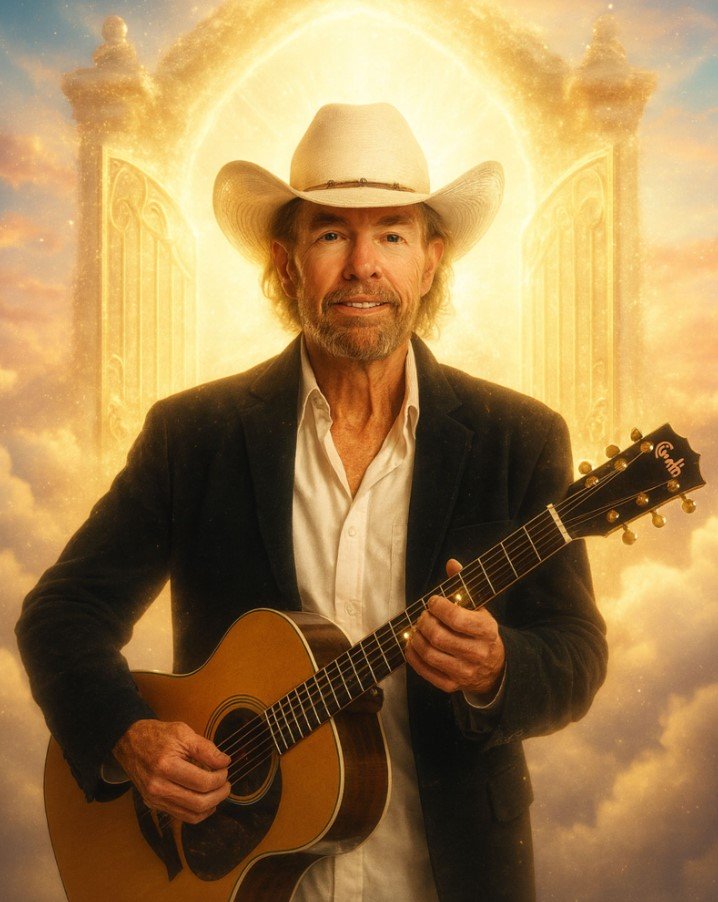
A Hidden Recording Unearthed After a Legend’s Final Sunset
In the quiet stillness following Toby Keith’s passing, a discovery emerged that reshaped how we understand his final years. Inside his weathered guitar case—nestled beside the instrument he famously called “Faith”—a small flash drive labeled “For Her” was found. What rested on that drive was not a studio-polished track, not a commercial demo, but a private song Toby Keith recorded alone, late at night, during the most vulnerable season of his life. It was a song never intended for charts or airwaves. It was a message sealed in melody, written with the knowledge that time was slipping away.
A Song Crafted in Solitude and Honesty
During his battle with illness, Toby often retreated into his home studio, where the noise of the world faded and truth could rise unfiltered. This undiscovered song was born in those moments—when the cameras stopped flashing, when the crowds faded, and only his voice, his guitar, and his memories remained. The recording captures him at his rawest: softer, slower, and undeniably sincere. The simplicity is its power. There are no layered harmonies, no full-band crescendos—just Toby’s unmistakable voice speaking directly from his soul.
One lyric stands as the heart of the entire piece: “If I don’t make it to the sunrise, play this when you miss my light.” It is the line of a man who understood the weight of his goodbye, yet chose to deliver it gently.
Why the Song Was Never Released
Toby Keith was known for songs that carried grit, humor, patriotism, and heart. But this song belonged to none of those categories. It was intimate, personal—almost sacred. It wasn’t written for fans, radio stations, or record labels. It was written for one person. The label “For Her” remains part of the mystery. Some believe it was meant for his wife. Others suggest it was intended for his family. And a few think “Her” meant something even broader: the spirit of the woman he sang to in countless past songs, the muse that shaped his storytelling.
What is clear is this: Toby did not release it because he never meant for the world to hear it. This was not a track crafted for legacy—it was crafted for closure.
A Farewell Meant for Heaven, Not for Broadcast
Listening to the recording, one hears more than music. One hears a man making peace. His voice carries a warmth that feels like the final glow of a campfire. The song’s message doesn’t chase fame; it seeks comfort. It feels like a prayer whispered into the dark, left as a final offering. Even those who have only heard descriptions of the song describe it the same way: a goodbye wrapped in grace.
For fans, the discovery doesn’t feel like uncovering a lost hit. It feels like being granted a glimpse into a part of Toby Keith’s heart he never planned to share. A final gift—quiet, fragile, and profoundly human.
A Legacy Strengthened by a Song the World Wasn’t Supposed to Hear
Toby Keith left behind countless anthems that defined generations. Yet this private track, hidden until after his death, deepens his legacy in an unexpected way. It shows us the man behind the legend—the one who wrote for the world, but saved his most vulnerable truth for someone he loved.
The song remains unreleased, and perhaps it always should. Some melodies are meant not to be broadcast, but to be remembered. In discovering it, we are reminded that even legends carry quiet stories meant for the spaces between the spotlight.
Toby Keith’s final message may never echo across radio towers—but it echoes in the hearts of those who now know it existed.